
90% less effort, 10x faster – how UIC and AI re-engineered pension document processing.
Data shown is for demonstration purposes only
- 90% reduction in manual effort
- 10x faster data discovery and validation
- Multi-million £ potential cost savings anticipated on large-scale cleanses
- Full compliance readiness for upcoming 2026 regulations
- Higher staff confidence and significantly less rework
Using AI to transform the speed, accuracy and scalability of complex data-processing workflows.
Hymans Robertson partnered with UIC Digital to harness the power of AI to solve one of pension administration’s most complex challenges, extracting and verifying key data buried within decades of unstructured member documents. The resulting AI-driven platform uses machine learning to read, interpret and cross-reference millions of records, enabling faster, more accurate data validation and transforming a previously manual, time-intensive process into an intelligent, scalable workflow.
Data shown is for demonstration purposes only
The challenge.
Hymans Robertson, one of the UK’s leading pension and investment consultancies, administers over 200,000 pension scheme members across more than 70 clients. For decades, structured member data in their UPM system has been accompanied by millions of unstructured “backfiles” — scanned letters, forms, and PDFs dating back 40 years or more.
Historically, every backfile review was a manual process. Each record could take 15–45 minutes to review, with administrators opening hundreds of documents in search of a single missing or unverified data point. The work was described internally as “a very, very boring job” — repetitive, error-prone, and costly to clients.
The additional challenge is that new regulations, due to take effect in October 2026, required that member data be accurate and always evidenced, not only at the point of retirement. Current, manual methods cannot scale to meet that obligation.
The solution.
Following a successful proof of concept that demonstrated the potential of AI to interpret unstructured pension documents, Hymans Robertson commissioned UIC Digital to deliver a full production system: the TPA AI Backfile platform.
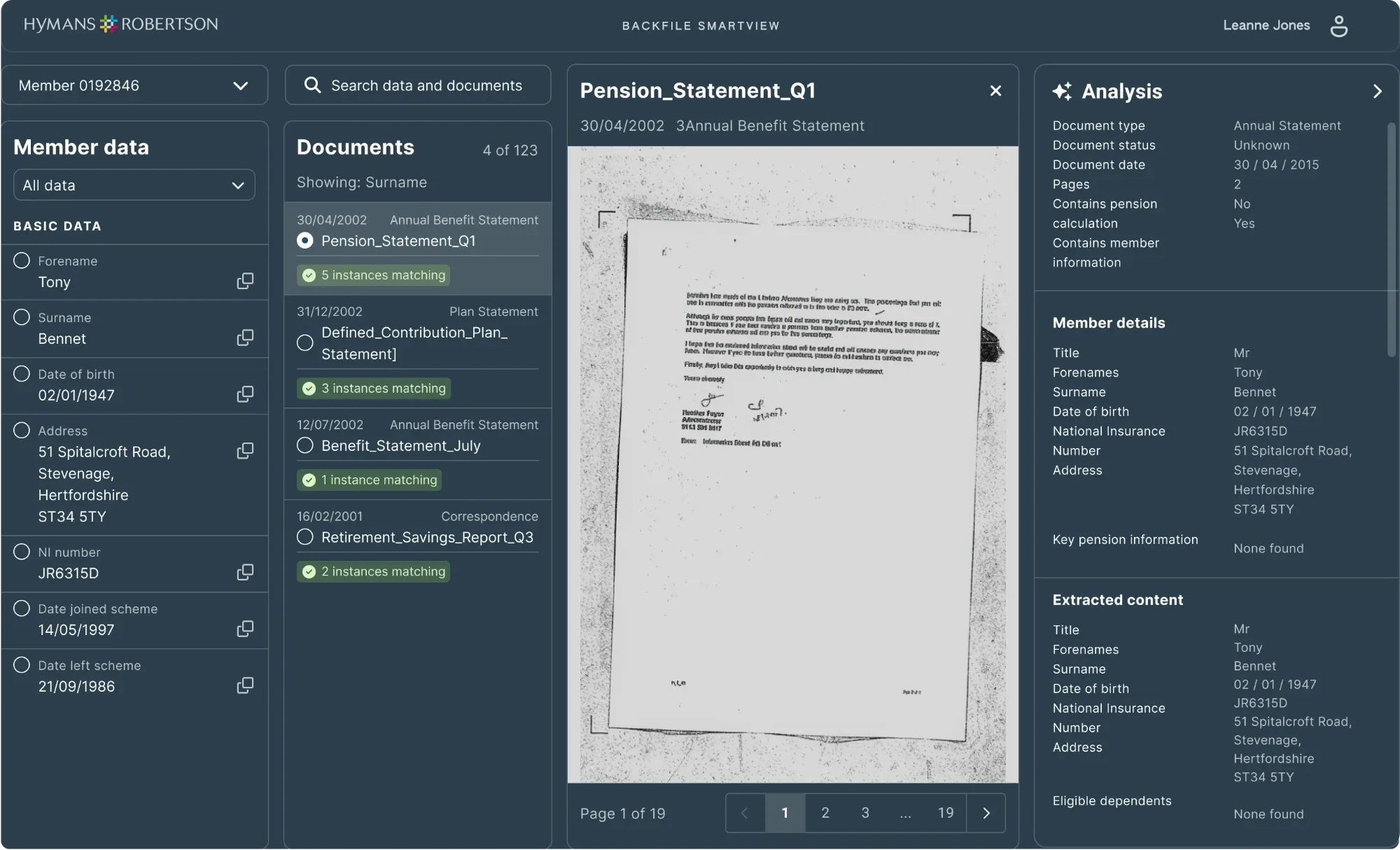
The platform automatically reads, interprets and indexes key data from backfiles associated with each pension scheme member. Using OCR and large-language-model analysis, it identifies data such as dates, salaries, contributions and spouse details, highlights their exact location within the original document, and presents them in a clear, auditable interface.
UIC provided end-to-end delivery, designing and engineering both the backend AI pipeline and frontend application. The front end was built using Hymans Robertson’s existing in-house design system to ensure consistency with their digital estate, while UIC focused on the user experience design and technical architecture.
Data shown is for demonstration purposes only
How we did it: the five stages of PRIME.
We moved from a complex data challenge to a production environment in months rather than years, on the five stages we run every engagement through.
Prepare. No months of discovery. Short, focused workshops instead, bringing together the doers and the checkers from the Glasgow headquarters, so the system was solving real workflow pain from day one rather than a version of it drawn on a whiteboard.
Roadmap. Those workshops pinpointed the specific value levers: the high-value data points with the greatest impact on regulatory compliance and operational cost. That ranking is what made a months-long build possible: we knew which data mattered before writing anything.
Implement. A proof of concept first, then the production system. We engineered the full stack, integrating AI document processing with a secure Azure-hosted backend, and deployed it as a production-ready platform rather than a pilot, wired into Hymans’ single sign-on and built on their existing in-house design system, which is what made adoption immediate.
Monitor. The focus throughout was workflow fit: every data point the system surfaces carries a verifiable link back to its source page. That is the transparency pension auditing requires, and it is what lets the established doer and checker process stay in place around the tool rather than be replaced by it.
Evolve. Continuous learning, with the tool assisting human expertise rather than substituting for it, and scaling across multiple pension schemes.
The outcome: unlocking value.
By applying the PRIME framework, we transformed a “boring,” manual task into a streamlined, verifiable process. The speed of the PRIME methodology resulted in immediate gains:
- Efficiency: Record review times reduced from 30 minutes to just 3 minutes.
- Velocity: Data cleansing cycles that previously took four months are now completed in six weeks.
- Regulatory assurance: A consistent, auditable data trail that secures Hymans Robertson’s position for the 2026 regulatory shift.
Through the PRIME framework, we moved Hymans Robertson from a whiteboard concept to a market-leading AI administration tool at pace.
It starts with two days.
Enough to know what to build first, and what it will cost.